


A polite, confident and obedient dog is developed through regular training. Many people think that training a dog is difficult, but if you follow the right method, the matter becomes quite easy. The purpose of training is not just to obey instructions, but to build mutual trust, understanding and a safe relationship between the owner and the dog.If you are starting to raise a new dog or have not achieved the desired results in previous training, then this guide will help you step by step.
Benefits of training a dog
With regular training, a dog’s behavior becomes much more controlled. It learns to remain calm in various situations in daily life and can interact positively with people.
Some other important benefits of training are—
- Learn to understand the owner’s instructions easily.
- Unwanted behavior decreases.
- Confidence increases.
- Mental stimulation is maintained.Security increases.
- It becomes easier to get along with family and other pets.
- The relationship between the owner and the dog becomes stronger.
How do dogs learn?
Dogs learn primarily from experience. If a behavior is followed by a positive outcome, the likelihood of repeating that behavior increases. Therefore, immediately giving praise, treats, or small rewards after a good deed greatly speeds up learning.
The same word should always be used for the same command. If everyone in the family follows the same rules, the dog will quickly understand what to do. Short, regular practice is usually more effective than long, continuous training.
Important dog training tips
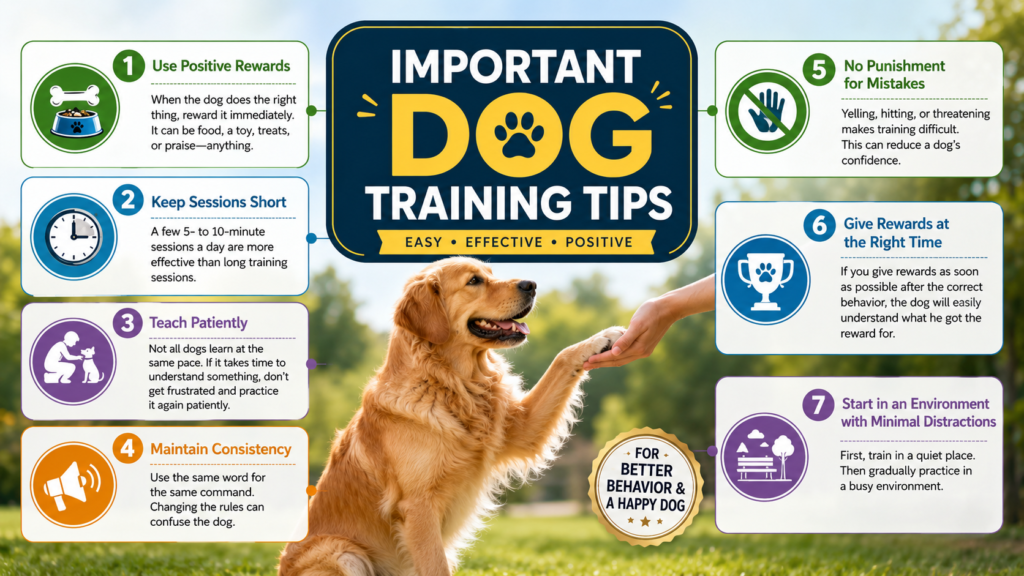
- Use positive rewards: When the dog does the right thing, reward it immediately. It can be food, a toy, treats, or praise—anything.
- Keep sessions short: A few 5- to 10-minute sessions a day are more effective than long training sessions.
- Teach patiently: Not all dogs learn at the same pace. If it takes time to understand something, don’t get frustrated and practice it again patiently.
- Maintain consistency: Use the same word for the same command. Changing the rules can confuse the dog.
- No punishment for mistakes: Yelling, hitting, or threatening makes training difficult. This can reduce a dog’s confidence.
- Give rewards at the right time: If you give rewards as soon as possible after the correct behavior, the dog will easily understand what he got the reward for.
- Start in an environment with minimal distractions: First, train in a quiet place. Then gradually practice in a busy environment.
Start basic training
- Sit: Get your dog’s attention by holding a treat in your hand. Slowly raise your hand upwards. Reward and praise him immediately when he sits.
- Down: Bring the treat down from a sitting position. Reward him when he lies down.
- Stay: Sit the dog and take a step back. Wait a few seconds and return to reward him. Gradually increase the time and distance.
- Come here: Smile and call the dog by his name. Praise and reward him immediately when he comes closer.
Toilet training
Take him to a designated place after eating, waking up, or playing. Praise him immediately when he defecates in the correct place. Follow a regular routine without punishment if an accident occurs.
Crate training
Introduce the crate as a comfortable and safe place. Use it for short periods of time at first and place food or toys inside to create a positive experience.
Clicker Training
Using a clicker, you can easily identify the moment of correct behavior. If you reward the dog immediately after clicking, the dog can quickly understand the relationship.
Loose Lead Walking
If the dog pulls on the leash while walking, stop. If the leash is loose, start walking again. With regular practice, he will gradually learn to walk nicely next to you.
Recall Training
Practice coming to a safe place by repeatedly calling him. Praise and reward him every time he returns successfully. Never punish him for coming close.
Puppy Training Classes
Training classes can be beneficial for new puppies. In addition to learning basic commands, they learn to socialize with other dogs and people.
Seek expert help if necessary
If the dog’s behavioral problems continue for a long time or aggressive behavior is observed, you should seek the advice of an experienced and qualified trainer or behaviorist.
Frequently Asked Questions (FAQs)
When is the right time to train a dog?
Puppies can usually start basic training from 8 weeks of age. However, adult dogs can also be successfully trained.
How long should a dog be trained each day?
Small, 5-10 minute sessions each day are usually most effective. This keeps the dog focused and makes it easier to learn.
Should food be used as a reward during training?
Yes. Small, healthy treats, praise, or treats—all can be used as positive rewards. Dogs learn quickly.
What to do if your dog doesn’t follow commands?
Be patient and practice the same commands regularly. Reward your dog for good behavior without yelling or punishing.
How long does it take to teach a dog to “sit” and “wait”?
Every dog learns at a different pace. With regular practice, many dogs learn basic commands within a few days to a few weeks.
What is the best way to stop a dog from pulling on a leash?
Stop walking your dog when he pulls on the leash. If the leash becomes loose, start walking again. With consistent practice, he will gradually learn to walk alongside you.
How long can toilet training take?
This depends on the dog’s age, habits, and consistency of training. Following a specific routine makes learning easier.
Can older dogs be retrained?
Of course. With the right approach, patience, and regular practice, even adult dogs can learn new habits and commands.
When should you seek help from a professional dog trainer?
If your dog’s behavior is out of control, aggressive, or doesn’t improve after a long period of trying, it’s a good idea to seek help from a qualified trainer.
What is the most important rule of dog training?
Consistency, patience, and positive rewards—these are the three most important foundations of successful dog training.
Conclusion: The Foundation of Successful Dog Training
The foundation of dog training is patience, regular practice, and positive reinforcement. Even a small amount of time each day will yield good results. By using praise, rewards, and consistent rules instead of harsh punishment, your dog will not only learn to obey commands, but will also become a more confident, calm, and loyal member of the family.