

Training a dog starts with teaching clear, consistent commands that help build communication between you and your pet. Basic obedience commands improve safety, encourage good manners, and make daily life easier for both dogs and their owners.
Whether you have a young puppy or an older dog, mastering a core set of obedience commands creates the foundation for advanced training and strengthens your bond. This guide covers the most important commands every dog should know and explains how to teach them effectively.
Overview: The Essential Obedience Commands
Basic obedience training focuses on commands that help control behavior, improve responsiveness, and keep dogs safe in different situations.
The most important commands include:
- Sit
- Down
- Stay
- Come
- Heel
- Drop It
- No
These commands provide a strong training foundation and can be practiced in almost any environment.
The Training Order
While every dog learns at a different pace, teaching commands in a logical sequence often produces the best results.
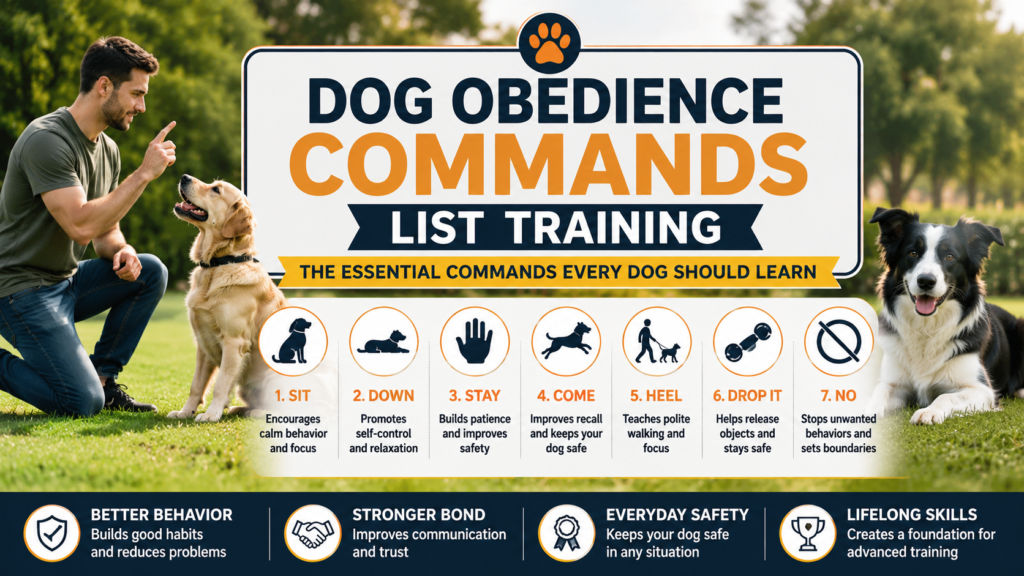
A common progression is:
- Sit
- Down
- Stay
- Come
- Heel
- Drop It
- No
Starting with simpler commands helps dogs build confidence and prepares them for more challenging exercises later.
1. Sit
The sit command is usually the first obedience skill dogs learn. It is simple, practical, and useful in countless situations.
Why Teach Sit?
- Encourages calm behavior
- Helps control excitement
- Creates focus during training
- Serves as a foundation for other commands
How to Teach Sit
Hold a treat near your dog’s nose and slowly move it upward. As your dog follows the treat with their eyes, their rear naturally lowers toward the ground.
The moment your dog sits, reward them immediately and praise them enthusiastically.
Repeat the exercise several times until your dog consistently responds to the verbal cue.
2. Down
The down command teaches a dog to lie calmly on the ground and remain relaxed.
Benefits of the Down Command
- Promotes self-control
- Reduces hyperactive behavior
- Helps dogs settle in public places
- Supports advanced obedience training
How to Teach Down
Start with your dog in a sitting position. Lower a treat from their nose toward the floor and slowly move it forward.
When your dog follows the treat and lies down, provide a reward and positive praise.
Practice in short sessions until the behavior becomes reliable.
3. Stay
Stay teaches a dog to remain in position until released.
Why Stay Matters
- Improves impulse control
- Increases safety around roads and crowds
- Helps during grooming and veterinary visits
- Encourages patience
How to Teach Stay
Ask your dog to sit or lie down.
Hold your hand up as a visual signal and say “Stay.
“Take one step back. If your dog remains in place, return and reward them.
Gradually increase distance and duration while continuing to reinforce success.
4. Come (Recall)
A dependable recall command can be one of the most important skills a dog learns.
Benefits of Recall Training
- Improves off-leash reliability
- Enhances safety
- Prevents dangerous situations
- Builds trust between dog and owner
How to Teach Come
Begin in a quiet environment with few distractions. Move a short distance away and enthusiastically call your dog’s name followed by the command “Come. “When your dog reaches you, reward generously with treats, praise, or play. Continue practicing in different locations as reliability improves.
5. Heel
Heel teaches a dog to walk politely beside its handler without pulling on the leash.
Why Heel Is Important
- Makes walks more enjoyable
- Reduces leash pulling
- Improves attention
- Encourages better control in public areas
How to Teach Heel
Keep your dog beside you and reward them for maintaining position. Take a few steps forward and provide treats when your dog remains close. Gradually increase walking distance while rewarding consistent behavior. Practice regularly in both quiet and distracting environments.
6. Drop It
Drop It teaches a dog to release an object on command.
Benefits of Teaching Drop It
- Prevents resource guarding
- Protects dogs from dangerous objects
- Makes play safer
- Encourages cooperation
How to Teach Drop It
Offer your dog a toy and allow them to hold it. Present a high-value treat and say “Drop It.” When your dog releases the object, reward immediately. Repeat the exercise with different items to strengthen understanding.
7. No
The No command communicates that a behavior is not acceptable.
When to Use No
- Jumping on people
- Chewing inappropriate items
- Unwanted behaviors
- Ignoring boundaries
How to Teach No
Use a calm but firm voice whenever undesirable behavior occurs.
Redirect your dog toward an appropriate action and reward the correct choice.
Consistency is critical for helping dogs understand expectations.
Your Command Progress
Track progress by practicing each command regularly and increasing difficulty gradually.
Focus on:
- Response speed
- Consistency
- Reliability around distractions
- Ability to follow commands in new environments
Patience and repetition are key to long-term success.
Hand Signals and Why They Matter
Dogs often respond exceptionally well to visual cues. Adding hand signals alongside verbal commands can:
- Improve communication
- Increase response accuracy
- Help dogs work in noisy environments
- Support older dogs with hearing challenges
Use the same hand signal every time to avoid confusion.
Training Rules for All Commands
Successful obedience training depends on consistency and positive experiences.
Follow these general guidelines:
- Keep sessions short and engaging
- Reward desired behaviors immediately
- Use clear commands
- Practice daily
- Remain patient
- Train in various locations
- Gradually introduce distractions
Dogs learn best when training remains enjoyable and rewarding.
Common Mistakes
Many training challenges result from avoidable errors.
Common mistakes include:
- Inconsistent commands
- Repeating cues excessively
- Training sessions that are too long
- Rewarding at the wrong time
- Moving too quickly through training stages
- Practicing only at home
Avoiding these mistakes can significantly improve results.
Frequently Asked Questions: dog obedience commands list training
What Are the 7 Basic Commands for Dogs?
The seven essential commands are Sit, Down, Stay, Come, Heel, Drop It, and No. Together they provide a strong foundation for obedience training.
In What Order Should You Train Dog Commands?
A common sequence is Sit, Down, Stay, Come, Heel, Drop It, and No. Beginning with simpler commands often leads to faster progress.
At What Age Can You Start Training Dog Commands?
Training can begin as soon as puppies arrive home. Young dogs are capable of learning basic behaviors through positive reinforcement.
How Many Commands Can a Dog Learn?
Many dogs can learn dozens of commands throughout their lives. The exact number depends on training consistency, motivation, and individual ability.
Why Does My Dog Only Respond to Commands at Home?
Dogs often struggle to generalize behaviors to new environments. Practicing in different locations helps improve reliability.
Should I Use Hand Signals or Words?
Using both verbal commands and hand signals typically produces the best results. Combining the two forms of communication improves clarity and consistency.
Conclusion: Smart Dog Training Success with Dog Obedience Commands List
A well-trained dog is easier to manage, safer in everyday situations, and more enjoyable to live with. By focusing on essential obedience commands such as Sit, Down, Stay, Come, Heel, Drop It, and No, you can establish clear communication and build a strong training foundation. Consistent practice, positive reinforcement, and patience will help your dog develop reliable obedience skills that last a lifetime.