

The next step in general obedience training for dogs is Advanced Obedience Training. At this stage, the dog not only follows known commands, but also learns to remain calm in different situations, understand instructions, and communicate better with the owner. This training focuses on improving the dog’s attention, control, and responsiveness.
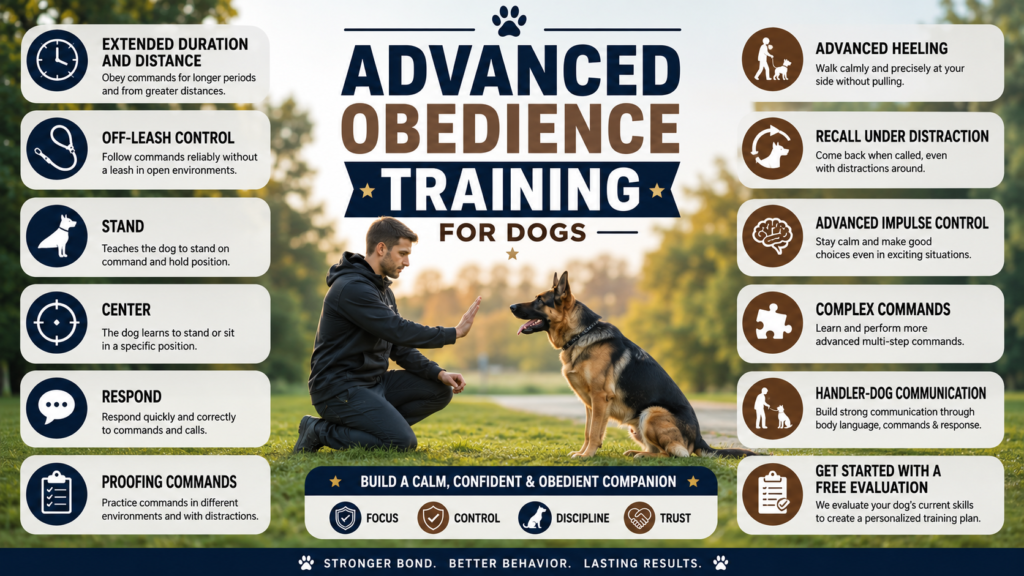
Extended Duration and Distance
In this stage, the dog is taught to obey a command for a longer period of time. For example, after giving a command such as sit or wait, the dog should be able to maintain its position even if it moves some distance. The time and distance are gradually increased, so that the dog can obey the command more steadily.
Off-Leash Control
Off-Leash Control means controlling the dog without a leash.Through this training, the dog learns to follow the owner’s commands, even when it is not on a leash. This skill is important for controlling the dog’s behavior outdoors or in open spaces.
Stand
The Stand command teaches the dog to stand. This command helps the dog change its body position and remain still according to a specific command.
Center
The Center command teaches the dog to stand or sit in a specific position. This helps to create good coordination between the dog and the owner.
Respond
Respond training teaches the dog to respond quickly and correctly to commands. The main point of this section is that the dog pays attention to the owner’s call and responds as needed.
Proofing Commands
Proofing Commands is practicing known commands in different situations. This exercise is done so that the dog can follow the command even in different environments, sounds or distractions.
Advanced Heeling
In Advanced Heeling training, the dog is taught to walk correctly with the owner while walking. The dog is trained to walk in a specific position without pulling.
Recall under Distraction
This stage teaches the dog to return when called, even under various distractions. Paying attention to the owner’s call even when there are other things around is an important part of this training.
Advanced Impulse Control
Impulse Control means controlling one’s own behavior. This training teaches the dog to remain calm and respond thoughtfully even in agitated situations.
Complex Commands
The Complex Commands section teaches the dog to follow more difficult commands. The habit of understanding and working with multiple steps is developed.
Handler-Dog Communication
Good training requires clear communication between the owner and the dog. This section emphasizes improving the understanding between the two through body language, commands, and responses.
Get Started with a Free Evaluation
Before starting Advanced Obedience Training, the dog’s current behavior and skills are evaluated. Through an accurate evaluation, the training path can be determined according to the dog’s needs.
FAQs About Advanced Obedience Training for Dogs and Effective Methods
What is advanced obedience training for dogs?
Advanced obedience training is a higher level of dog training that helps dogs improve their response to commands, focus, control, and communication with their handler.
When should a dog start advanced obedience training?
A dog can move to advanced obedience training after learning basic commands and showing a good understanding of basic obedience skills.
What skills are included in advanced obedience training?
Advanced obedience training may include off-leash control, longer duration commands, distance control, advanced heeling, recall, impulse control, and more complex commands.
Why is off-leash control important?
Off-leash control helps a dog follow the handler’s instructions even without a leash, improving control in different environments.
What does advanced heeling teach a dog?
Advanced heeling teaches a dog to walk properly with the handler while maintaining attention and position.
How does recall training help a dog?
Recall training helps a dog return to the handler when called, even when there are distractions around.
What is impulse control in dog training?
Impulse control helps a dog manage excitement and respond calmly instead of reacting immediately.
Can advanced obedience training improve communication between a dog and owner?
Yes, regular training helps improve understanding, cooperation, and communication between the dog and the handler.
How long does advanced obedience training take?
The time depends on the dog’s current skills, consistency of practice, and the training goals.
Is advanced obedience training suitable for every dog?
Advanced obedience training can be adjusted based on a dog’s ability, behavior, and learning progress.
Conclusion: Advanced Obedience Training for Dogs – Ultimate Discipline & Control Guide
Advanced Obedience Training is not just about teaching your dog commands. It is a continuous process of improving a dog’s attention, control, and ability to follow their owner’s commands. With time, patience, and regular practice, a dog learns to remain calm and respond appropriately in a variety of situations. Good training strengthens the trust and understanding between dog and owner.
Get Started with a Free Evaluation
It is important to start training properly by understanding your dog’s current skills and behavior. An evaluation can help determine the next steps in training based on your dog’s needs.